

What Is a Cashmere Blend? And How Is It Different From Original Cashmere Fiber?
If you’ve ever reached for a sweater and felt that instant softness against your skin — you already know why cashmere matters.
But here’s where it gets confusing: cashmere blend vs pure cashmere. Two labels. Two very different products. And most shoppers don’t know the difference until after they’ve bought.
In this guide, we compare cashmere blend vs pure cashmere to help you choose the right one — based on your lifestyle, budget, and what you actually need from your knitwear.
The difference isn’t just in the fabric — it’s in how it feels every time you wear it.
What Is Pure Cashmere?
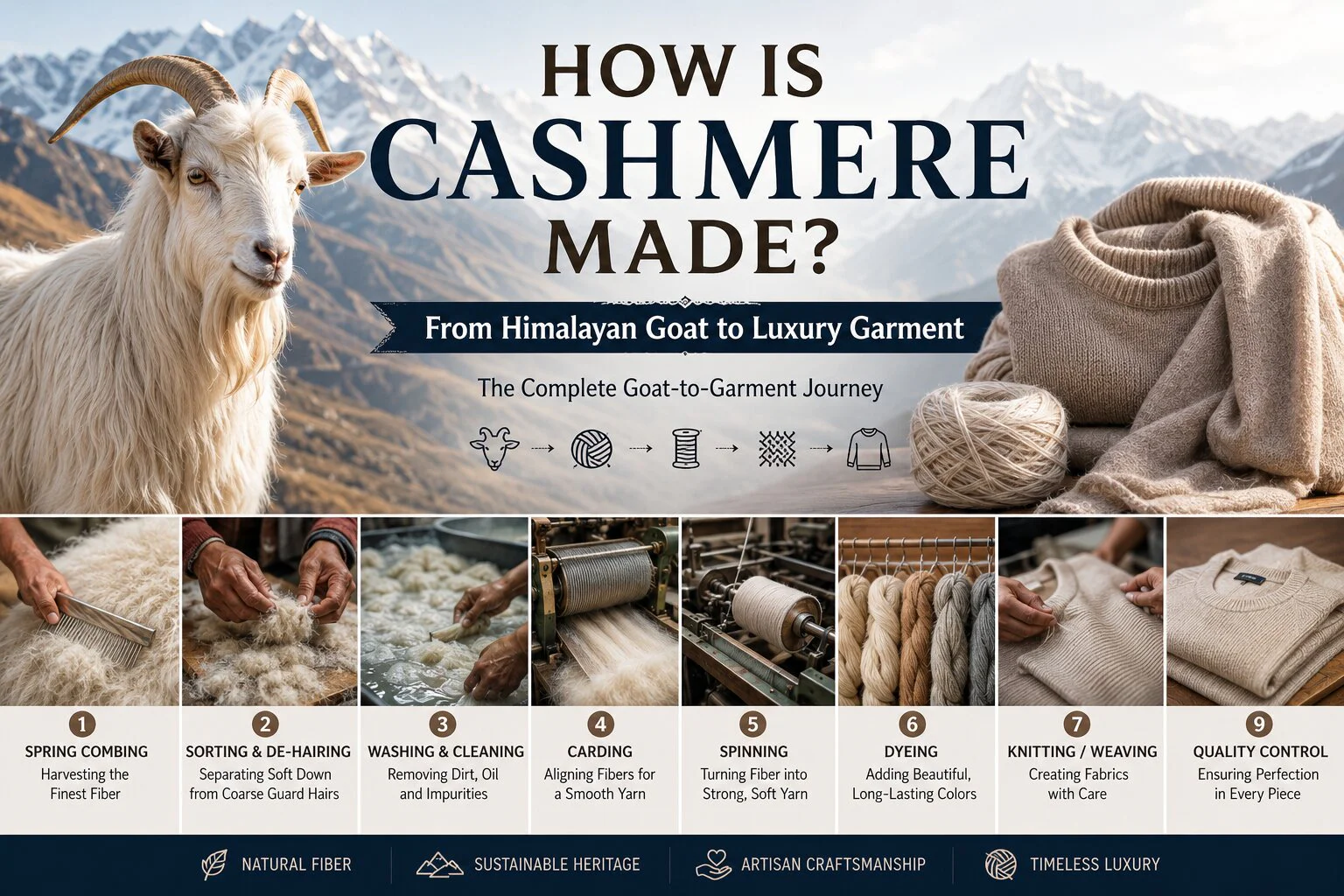
Cashmere is a natural fiber harvested from the soft undercoat of Cashmere goats, raised in the high-altitude regions of Mongolia, Nepal, China, and Central Asia.
What makes it exceptional:
- Incredibly fine fibers (measured in microns) that feel feather-soft against skin
- Lightweight warmth — it insulates without adding bulk
- Naturally breathable across seasons
- Long-lasting when properly cared for
Pure cashmere is graded by fiber fineness and length. The finer and longer the fiber, the higher the quality — and the higher the price. A single quality cashmere garment can require the annual yield of several goats, which is why it commands a premium.
What Is a Cashmere Blend?
A cashmere blend is a fabric made by combining cashmere fibers with one or more other materials — such as merino wool, silk, cotton, nylon, or acrylic.
The result: a fabric that carries some of cashmere’s signature softness and warmth, while the added fibers bring their own strengths.
Common cashmere blend combinations:
- Cashmere + Merino Wool — Warmer, more durable, holds shape well
- Cashmere + Silk — Lightweight with a beautiful drape and natural sheen
- Cashmere + Cotton — Breathable and ideal for transitional seasons
- Cashmere + Nylon or Acrylic — Stronger, more resistant to pilling, more affordable
The cashmere percentage varies widely. Blends with 70–90% cashmere feel close to pure. Those with 10–20% cashmere are mostly felt in price — not in luxury.
Diamond Knitland Tip: Always check the fiber percentage on the label. A cashmere blend with less than 30% cashmere will feel noticeably different from one with 70% or more.
Cashmere Blend vs Pure Cashmere: A Full Comparison
This is the question most buyers are really asking. Here’s a direct, honest breakdown:
Softness and Feel
Pure cashmere is unmatched in softness. The ultra-fine fibers feel gentle and luxurious against bare skin — often described as wearing a cloud.
Cashmere blends can still be very soft, especially those blended with silk or fine merino. However, coarser companion fibers like acrylic or standard wool reduce that signature cashmere feel.
Warmth and Insulation
Pure cashmere offers an outstanding warmth-to-weight ratio — deeply warm without feeling heavy.
A cashmere wool blend can actually be warmer overall, since wool adds extra insulation. This makes it ideal for colder climates and heavy winter knitwear.
Durability and Longevity
This is where blends often have a real edge.
Pure cashmere, despite its beauty, is delicate — prone to pilling, stretching, and wear without careful handling.
Cashmere blends — particularly those with merino wool or nylon — are more resilient. They hold their shape better, resist pilling, and handle frequent wear and washing more confidently.
Price Point
Pure cashmere is significantly more expensive. Premium garments can cost hundreds of dollars, reflecting the rarity and labor involved in production.
Cashmere blends are more accessible — sometimes dramatically so — without fully sacrificing the luxury feel. For everyday knitwear, a well-made blend delivers exceptional value.
Ease of Care
Pure cashmere requires gentle hand washing or dry cleaning.
Many cashmere blends — depending on companion fibers — can be machine washed on a delicate cycle. Significantly more practical for daily use.
Pure Cashmere vs Blended Cashmere: Side-by-Side
| Pure Cashmere | Cashmere Blend | |
|---|---|---|
| Softness | Exceptional | Very good (varies by blend) |
| Warmth | High | High to Very High |
| Durability | Moderate | Good to Excellent |
| Price | Premium | Affordable to Mid-range |
| Care | Delicate | Often easier |
| Best for | Special occasions, gifts, heirloom pieces | Everyday wear, active lifestyle, value-focused buyers |
Is Cashmere Blend Good Quality?
Yes — when made well.
Quality in a cashmere blend depends on two things: the cashmere percentage and the quality of the companion fibers.
A well-crafted blend from a manufacturer like Diamond Knitland uses premium-grade cashmere combined with carefully selected partner fibers. The result is a garment that is soft enough to feel indulgent and durable enough for real life.
Low-quality blends, on the other hand, use minimal cashmere with cheap synthetics — rough to the touch, quick to pill, and slow to impress.
This is why the brand and sourcing behind the blend matters just as much as the label.
Cashmere Blend Fabric Benefits: Why Many Buyers Prefer a Blend
There are real, practical reasons experienced knitwear shoppers choose cashmere blends:
- More affordable without losing the essential cashmere feel
- Greater durability — holds shape and resists pilling better over time
- Versatile for different seasons — silk and cotton blends work beautifully in spring and autumn
- Easier to care for — many blends tolerate machine washing on a gentle cycle
- Wider design range — blending fibers gives designers more flexibility in weight, texture, and drape
- Sustainable options available — some blends incorporate recycled fibers alongside cashmere
Explore our cashmere blend knitwear collection to find styles crafted for everyday luxury.
Cashmere vs Wool Blend: What’s the Difference?
Another common point of confusion:
- Pure wool is warm and hardwearing, but coarser than cashmere
- A cashmere-wool blend brings cashmere’s softness into a more affordable, resilient fabric
- Pure cashmere is lighter and softer than wool, but more delicate
For everyday winter staples — sweaters, cardigans, scarves, and beanies — a cashmere-merino blend hits the sweet spot. You get cashmere’s softness with merino’s strength.
Browse our cashmere sweaters and cashmere scarves crafted from our finest blended yarns.
How to Identify a Quality Cashmere Blend
Before you buy, here’s what to check:
- Cashmere content of at least 40–50% — below this, the cashmere feel is minimal
- Softness on touch — a good blend feels smooth, never scratchy or stiff
- Natural weight and drape — quality blends have substance; cheap synthetics feel limp
- Transparent labeling — reputable brands clearly state fiber percentages
- Brand reputation — look for manufacturers with traceable sourcing and quality standards
Which Should You Choose: Cashmere Blend or Pure Cashmere?
It comes down to your priorities:
Choose pure cashmere if:
- You want the absolute finest, most luxurious feel
- You’re buying a special occasion piece, a gift, or a wardrobe investment
- You’re willing to care for it carefully over time
Choose a cashmere blend if:
- You want everyday luxury without the premium price
- You need garments that hold up to regular wear and washing
- You’re building a versatile seasonal wardrobe
Both are worth owning. One earns its place in your most treasured moments. The other earns its place in your everyday life.
Final Thoughts: Cashmere Blend vs Pure Cashmere
Understanding the difference between cashmere blend vs pure cashmere helps you shop smarter — and dress better.
Pure cashmere is a timeless investment in softness and luxury. A well-made cashmere blend is a practical investment in everyday quality. The right choice depends on how, when, and how often you plan to wear it.
At Diamond Knitland, both are crafted with the same commitment: exceptional fiber, honest sourcing, and knitwear made to last.
Frequently Asked Questions
Is cashmere blend real cashmere?
Yes — cashmere blend contains real cashmere fibers, mixed with one or more other materials. The key difference is the percentage. A blend with 70%+ cashmere will feel close to pure; one with 20% or less will feel noticeably different.
Is cashmere blend worth buying?
Absolutely. A high-quality cashmere blend offers much of cashmere’s softness and warmth at a more accessible price point — with added durability. For everyday wear, it’s often the smarter choice.
How long does cashmere blend last?
With proper care, a quality cashmere blend can last many years — often longer than pure cashmere, because the companion fibers add resilience and resistance to pilling and stretching.
Which is better: cashmere or cashmere blend?
Neither is universally better — it depends on your needs. Pure cashmere is superior in softness and prestige. Cashmere blends offer better durability, lower price, and easier maintenance. Both are high-quality choices when made well.
What percentage of cashmere is good in a blend?
Look for at least 40–50% cashmere for a noticeably luxurious feel. Blends with 70% or more cashmere feel very close to pure, while blends below 30% offer limited cashmere benefit.
Explore our full cashmere and cashmere blend collection — and feel the difference for yourself.
Questions about our fibers or knitwear? Reach out to the Diamond Knitland team — we’re always happy to help.




Add comment
You must be logged in to post a comment.