
How Is Cashmere Made? The Complete Goat-to-Garment Journey (2026 Guide)
Cashmere is more than a fabric. It is the product of extreme geography, centuries of herding knowledge, meticulous hand labor, and fiber science working together across months before a single stitch is knit. When you hold a cashmere sweater and feel its weight — light yet warm, impossibly soft — you are holding the result of a process that begins at 14,000 feet in the Himalayas and passes through more than a dozen skilled hands before it reaches yours.
This guide walks through every stage of cashmere production, from the goats themselves to the finished garment, with particular attention to how Nepal’s artisan manufacturers approach the craft differently from mass-market producers.
How Is Cashmere Made? (Quick Answer)
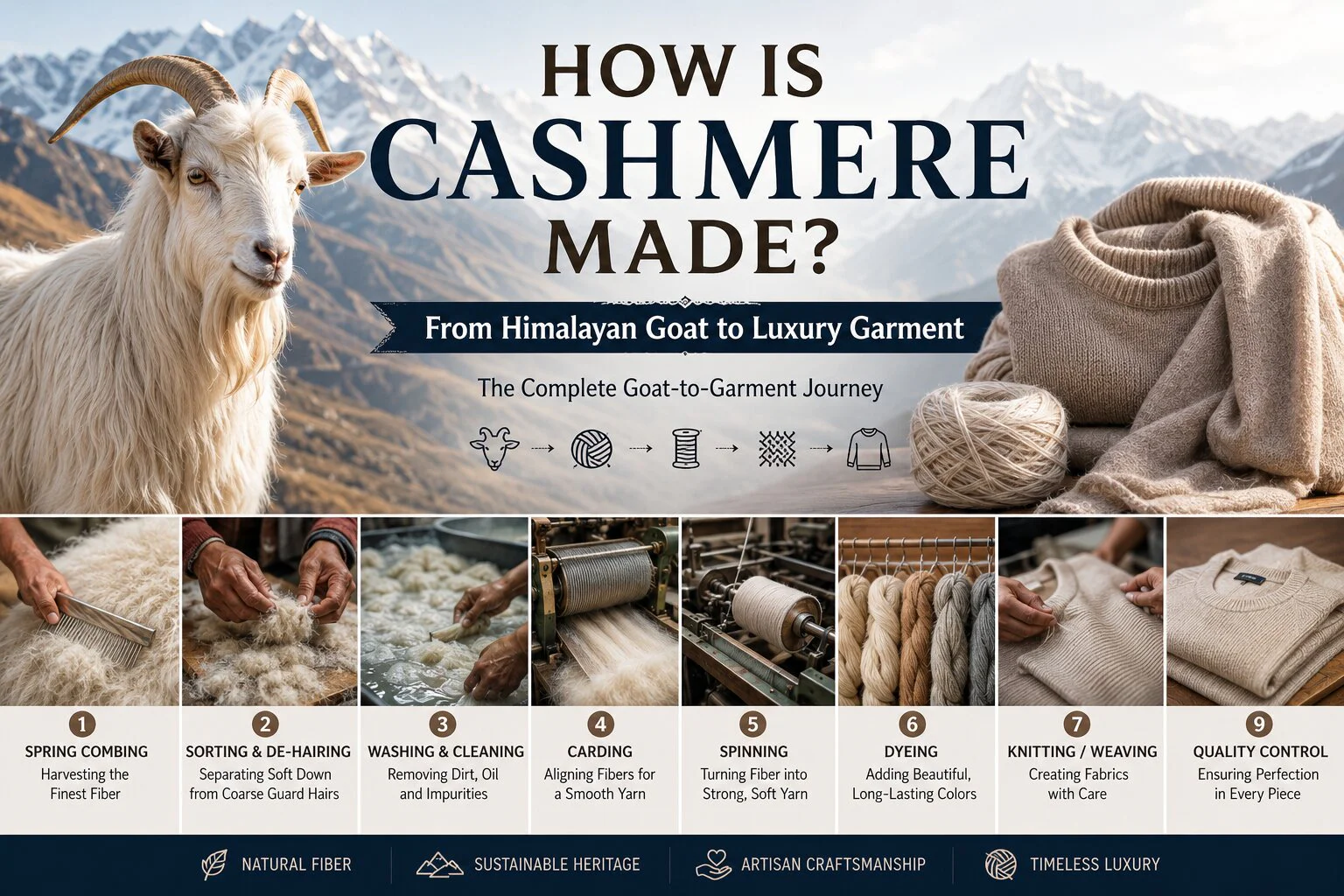
Cashmere is made from the soft undercoat of cashmere goats. During spring, goats naturally shed this fine fiber, which is collected through hand-combing or shearing. The raw cashmere is then sorted, de-haired, washed, carded, spun into yarn, dyed, and finally knitted or woven into garments such as sweaters, scarves, shawls, and blankets.
The cashmere production process consists of 9 main steps:
- Harvesting cashmere fibers
- Sorting and de-hairing
- Washing and cleaning
- Carding fibers
- Spinning yarn
- Dyeing
- Weaving or knitting
- Finishing and softening
- Quality inspection
Cashmere Production Process at a Glance

Cashmere by the Numbers
- One goat produces only 100–350 grams of cashmere annually
- A sweater typically requires fiber from 2–4 goats
- Premium cashmere measures 14–19 microns in diameter
- Cashmere can be up to 8 times warmer than regular wool by weight
- Cashmere is harvested only once per year per goat
What Is Cashmere and Where Does It Come From?
Understanding Cashmere Fiber
Cashmere is not wool in the conventional sense. It comes from the fine, downy undercoat of cashmere goats rather than the outer fleece of sheep. The two fibers feel entirely different in hand: where standard sheep wool can measure anywhere from 20 to 40 microns in diameter, premium cashmere typically measures between 14 and 19 microns. The finest grades — what Nepal’s highland Chyangra pashmina goats produce — can reach as low as 14 to 16 microns.
This fineness has practical consequences. Finer fibers bend more easily against the skin, which is why cashmere feels soft where wool can feel prickly. The fiber structure also traps more air per unit of weight, giving cashmere its paradoxical warmth-to-weight ratio: warm as wool, yet far lighter. With proper care, quality cashmere is also surprisingly durable, becoming softer with each wash rather than breaking down.
See also: Cashmere vs Wool — What’s the Real Difference?
The Cashmere Goat
The cashmere goat — specifically the Capra hircus laniger — is not a single breed but a category of goat that produces a fine undercoat in response to cold climates. The harsher the winter, the finer and denser the undercoat the goat grows as insulation. This is not incidental to cashmere quality; it is the reason cashmere quality is tied so directly to altitude and geography.
Main Cashmere-Producing Regions
Nepal produces some of the world’s finest pashmina-grade cashmere, drawn from Chyangra goats grazing above 4,000 meters in the Mustang, Dolpa, and Humla regions. Nepali cashmere and pashmina have centuries of artisan processing tradition behind them.
Mongolia is the world’s second-largest producer by volume. Mongolian cashmere is highly regarded for its softness and is used widely by international luxury brands.
China — specifically Inner Mongolia and Xinjiang — is the world’s largest producer by volume, accounting for a significant share of global raw cashmere supply. The quality range is wide, from commodity grades to premium fiber.
Tibet produces fiber similar to Nepal’s highland cashmere, given the shared geography and herd types.
India’s Ladakh region produces pashmina from Changthangi goats at high altitude, a fiber widely considered among the finest in the world.
Step 1 — Spring Combing Season: Harvesting Cashmere Fibers
Why Cashmere Is Collected in Spring
Cashmere goats naturally shed their winter undercoat in spring as temperatures rise. This shedding cycle is the production clock for the entire industry. There is one harvest per year, typically between March and May depending on altitude and region. Miss the window and the fiber is lost — the goat sheds it into the pasture.
This single annual harvest is one of the structural reasons cashmere is expensive. Unlike sheep that can be shorn multiple times per year, cashmere goats offer one yield per animal per year, with no exceptions.
Hand-Combing vs. Shearing
In Nepal and among traditional producers, cashmere is collected by hand-combing rather than shearing. Herders use fine-toothed combs to gently pull the loosening undercoat from the goat, separating it from the coarser outer guard hairs as they work.
| Feature | Hand-Combed | Sheared |
|---|---|---|
| Fiber Quality | Excellent | Good |
| Softness | Higher | Lower |
| Processing Required | Less | More |
| Animal Welfare | Better | Acceptable |
| Used for Luxury Cashmere | Yes | Sometimes |
How Much Cashmere Does One Goat Produce?
A single cashmere goat yields between 100 and 350 grams of usable undercoat per year, depending on the animal, its altitude, and the quality of the season. After de-hairing and cleaning, the usable fiber yield is lower still. A standard cashmere sweater requires approximately 200 to 300 grams of processed fiber — meaning one sweater may represent the annual yield of two to four goats.
Life in the Himalayan Highlands
In Nepal, the herders who keep Chyangra goats are often semi-nomadic communities in remote high-altitude districts. Their relationship with the animals spans generations. The goats graze on wild highland grasses and shrubs, requiring no feedlot inputs. This traditional pastoralism is inherently low-impact by modern agricultural standards.
Step 2 — Sorting and De-Hairing: Separating the Finest Fibers
What Happens After Collection?
Raw collected fiber is a mixture — fine undercoat, coarser guard hairs, vegetable matter, dust, and skin oils all together. Before anything else can happen, the fiber must be sorted and the coarse guard hairs removed. This step, called de-hairing, is arguably the most consequential quality-determining step in cashmere processing.
Removing Guard Hairs
The cashmere goat produces two types of fiber simultaneously. The outer coat — guard hair — is coarse, typically 40 to 90 microns in diameter, stiff, and lustrous. The undercoat — the cashmere — is fine, soft, and has the thermal properties cashmere is known for. If guard hairs remain in the finished product, they cause the prickling sensation associated with low-quality cashmere blends.
Hand-Sorting Process
Traditional Nepalese production relies heavily on hand-sorting. Skilled workers — often women with years of experience — spread the raw fiber on flat surfaces and separate it by hand and eye, feeling for coarser fibers and picking them out. Experienced sorters can identify quality differences by touch alone. Hand-sorting also allows for simultaneous color grading: raw cashmere comes in natural shades of white, brown, beige, and grey, which are separated at this stage.
Modern Mechanical De-Hairing
Larger processing facilities use mechanical de-hairing machines that use carding rollers, air jets, and combing systems to separate fine and coarse fibers efficiently. Premium producers often combine mechanical de-hairing with a hand-finishing pass to catch what machines miss.
Fiber Grading Standards
After de-hairing, fiber is graded on four dimensions:
Fiber diameter — measured in microns. Grades below 15.5 microns are considered ultra-fine pashmina grade. 16–18.5 microns is standard luxury grade. Above 19 microns is commercial grade.
Fiber length — longer staple fibers (typically 30–60mm) spin into stronger, more consistent yarn.
Color — white fiber is most valuable because it accepts dye most evenly.
Cleanliness — residual vegetable matter and contamination reduce grade.
Step 3 — Washing and Cleaning Raw Cashmere
Why Raw Cashmere Must Be Cleaned
De-haired fiber still carries lanolin (natural grease from the goat’s skin), dust, fine vegetable particles, and environmental contamination from months of outdoor grazing. Residual lanolin interferes with dyeing and makes the fiber feel greasy rather than soft. a
Traditional Washing Methods
Traditional washing in Nepal uses cool to lukewarm water — never hot, which causes fiber to felt and shrink — with gentle manual agitation and natural plant-based soap extracts. The fiber is laid out to dry in shade to prevent UV degradation.
Modern Eco-Friendly Cleaning Techniques
Contemporary processing facilities use controlled-temperature wash baths with biodegradable wool-safe detergents, typically between 30°C and 40°C. Multiple rinse cycles ensure all detergent residue is removed. Some facilities now recycle wash water, with growing adoption of low-water cleaning technologies.
Maintaining Fiber Softness During Cleaning
The critical risk in washing is mechanical damage to the fiber scale structure. Careful temperature control and minimal agitation preserve these scales — and with them, the softness and luster of the final fiber.
Step 4 — Carding and Preparing the Fiber
What Is Carding?
Carding is the process of disentangling, cleaning, and aligning the cleaned cashmere fibers into a consistent web that can be drawn into yarn. It uses fine wire-toothed rollers that separate and parallelize the fibers without breaking them.
Aligning the Fibers and Creating Slivers
Carding organizes fibers so they run roughly parallel to one another — essential for drawing into smooth, even yarn. The output is a continuous, loose rope of aligned fiber called a sliver, which is the feedstock for spinning. Its evenness directly determines the quality of the resulting yarn.
Quality Checks Before Spinning
At this stage, processors check the sliver for consistency, residual contamination, and fiber alignment before committing it to spinning. Any irregularities in the sliver produce defects in the yarn that cannot be corrected downstream.
Step 5 — Spinning Cashmere Yarn
How Cashmere Fibers Become Yarn
Spinning is the process of drafting (drawing out) the sliver to a finer diameter while simultaneously twisting it. The twist binds individual fibers together through friction, creating a continuous yarn with tensile strength. More twist creates a firmer yarn; less twist produces a softer, airier yarn.
Traditional Hand-Spinning
Hand-spinning using a drop spindle or charkha wheel was the historical method for cashmere and pashmina yarn in Nepal. The finest pashmina shawls of the Mughal era were woven from hand-spun yarn of extraordinary fineness. Hand-spun yarn has a characteristic organic irregularity that gives handmade fabric its warmth and texture — subtle variations that connoisseurs prize.
Modern Machine Spinning
Ring-spinning machines dominate commercial cashmere production, producing consistent, even yarn at high speed. These machines achieve remarkable consistency across an entire production run, which is essential for wholesale programs requiring batch-to-batch uniformity.
Hand-Spun vs. Machine-Spun Cashmere
| Feature | Hand-Spun | Machine-Spun |
|---|---|---|
| Texture | Organic, subtly irregular | Even, consistent |
| Consistency | Variable (artisan quality) | High |
| Production Speed | Slow | Fast |
| Cost | High | Lower |
| Character | Unique, artisan feel | Uniform |
Ply Construction and Yarn Strength
Most commercial cashmere yarn is plied — two or more single yarns are twisted together in the opposite direction to the original spin. Plying adds strength, reduces pilling, and improves stitch definition. A 2-ply yarn is standard for lightweight sweaters; heavier garments may use 3-ply or 4-ply construction.
Step 6 — Dyeing Cashmere: Adding Color to Luxury
Natural Colors of Cashmere
Raw cashmere comes in a range of natural shades: white, cream, light brown, beige, dark brown, and grey. Undyed natural-color cashmere products have a warmth and depth that synthetic dyes rarely replicate exactly.
Natural Dyeing Methods
Nepal has a rich tradition of plant-based dyeing. Walnut shells produce rich browns; indigo yields blues; madder root gives reds and oranges; turmeric and pomegranate rind provide yellows. Natural dyeing produces colors with an organic depth that many buyers prize, and is gaining renewed commercial attention due to growing demand for chemical-free products.
Modern Synthetic Dyeing
Reactive and acid dyes dominate commercial cashmere dyeing. They offer a far wider color palette, excellent colorfastness, and complete batch-to-batch consistency — essential for wholesale and retail programs where a buyer reorders the same colorway across multiple seasons. Cashmere is sensitive to heat and aggressive chemistry, so premium dyehouses carefully control temperature, pH, and processing time to minimize fiber damage.
Eco-Friendly Dyeing Innovations
Bluesign-certified dyes, GOTS-compliant dyeing processes, and low-water technologies are increasingly adopted by premium mills. Effluent treatment and water recycling in dyehouses are now standard among responsible manufacturers.
Step 7 — Weaving and Knitting Cashmere Fabric
Two Main Production Methods
Cashmere yarn is transformed into finished goods by two fundamentally different methods: weaving and knitting.
Weaving interlaces yarns at right angles to produce a flat fabric used for scarves, shawls, wraps, throws, and blankets. The resulting fabric is stable, drapey, and resistant to stretching.
Knitting creates fabric by interlocking loops of yarn. Knitted fabric has inherent stretch and recovery, making it ideal for shaped garments like sweaters and cardigans that need to conform to the body.
Traditional Hand Knitting in Nepal
Hand knitting and hand-loom weaving remain active in Nepal’s cashmere production ecosystem. Hand-knitted cashmere has a characteristic stitch clarity and density that differs perceptibly from machine-knitted equivalents. Traditional Dhaka weaving, pashmina shawl weaving on pit looms, and hand-loomed blanket production are all practiced in Nepal by artisans who have inherited these skills through family apprenticeship systems.
Modern Knitting Technology
Computerized flat-knitting machines — widely used in Nepal’s knitwear factories — can knit fully-fashioned garment panels or complete whole-garment pieces with essentially no cutting waste. They can produce complex stitch patterns, cables, jacquards, and intarsia designs at production speeds far beyond hand knitting.
Looking for Authentic Nepalese Cashmere?
Diamond Knitland manufactures premium cashmere sweaters, cardigans, scarves, shawls, blankets, and custom knitwear using carefully selected Himalayan cashmere fibers and traditional Nepalese craftsmanship.
Wholesale • OEM • Private Label Available
📧 biju@diamondknitland.com | 🌐 diamondknitland.com | 📱 +977 9851024416
Step 8 — Washing, Finishing, and Softening
The Finishing Process
A knitted or woven cashmere piece leaving the machine is stiff and rough — nothing like the soft, relaxed drape associated with finished cashmere. Finishing transforms it. The piece is washed again in a controlled environment using specialized conditioners that lubricate the fiber surface, enhance softness, and relax the yarn structure, allowing the fabric to bloom and loft.
Brushing and Raising the Nap
Many cashmere products are lightly brushed using fine wire brushes or teasel rollers. Brushing raises a soft surface nap, increasing perceived softness and giving the characteristic halo associated with brushed cashmere. Skilled finishers know exactly how much brushing is appropriate — too much weakens the fabric and increases pilling.
Shape Stabilization
Garments are blocked — stretched and pinned or steamed to precise measurements — after finishing to ensure dimensional stability. A well-blocked cashmere sweater holds its shape through repeated wearing and washing. Poor blocking results in garments that distort during the first wear.
See also: How to Remove Pilling from Cashmere Without Damage (2026 Guide)
Step 9 — Quality Control and Inspection
Why Quality Control Is Essential
At the volume and price point at which cashmere is sold, defects are costly. Serious cashmere manufacturers invest significantly in quality control systems that catch problems before garments leave the factory.
Fiber Testing
Premium producers test raw fiber before production begins. Micron measurement using optical fibre analysis provides objective confirmation of fiber fineness — fiber sold as 15-micron cashmere should measure at or below 15 microns. Mislabeled fiber is a persistent problem in the commodity cashmere market, making third-party testing important for buyers. Strength testing measures fiber tenacity to predict yarn breakage rates and garment durability.
Garment Inspection
Finished garments are inspected against a detailed specification sheet covering stitch quality (checking for dropped stitches, holes, and inconsistencies), shape consistency (measuring against the approved pattern), color accuracy (compared to an approved standard under controlled lighting), and surface quality (checking for pilling, snags, and finishing uniformity). Most premium manufacturers apply AQL (Acceptable Quality Level) inspection standards, randomly sampling from each production lot.
Final Packaging Standards
Cashmere garments are folded or rolled — never hung, as hanging causes elongation — wrapped in tissue, and boxed according to buyer specification. Care labels and composition labels must comply with the import regulations of the destination market.
How Many Cashmere Goats Does It Take to Make One Sweater?
| Product | Approximate Cashmere Needed | Approximate Goats Required |
|---|---|---|
| Scarf / Wrap | 50–100 grams | 1 goat |
| Lightweight Sweater | 150–200 grams | 1–2 goats |
| Standard Sweater | 200–300 grams | 2–3 goats |
| Cardigan | 250–350 grams | 2–4 goats |
| Blanket / Throw | 500–800 grams | 4–8 goats |
Note: These figures assume processed fiber weight after de-hairing and washing losses, which typically reduce raw collected fiber by 30–50%.
Why Cashmere Is Expensive
See also: Why Is Cashmere So Expensive? The Real Reasons Explained
The economics follow directly from the production constraints:
Limited supply — one harvest per goat per year, with yields measured in grams. Global raw cashmere supply is finite and cannot be quickly increased in response to demand spikes.
Labor-intensive processing — de-hairing, hand-sorting, hand-finishing, quality control, and blocking all require skilled human labor that cannot be fully automated without losing quality.
High material loss — 30–50% of raw collected fiber is lost in de-hairing and processing before any spinning begins.
Long lead times — from spring combing to finished garment involves multiple processing stages spread over weeks to months.
Why Nepal Is Famous for Premium Cashmere Manufacturing
Nepal occupies a uniquely advantageous position in the global cashmere industry — one that no other country can fully replicate.
Chyangra Goats at Himalayan Altitude
Nepal’s Chyangra goats graze above 4,000 meters in the remote districts of Mustang, Dolpa, and Humla. At these altitudes, winter temperatures drop to -30°C and below. The undercoat these goats produce in response to such conditions is among the finest natural fiber on earth — measuring 14 to 16 microns, finer than most commercial cashmere and rivaling the finest Changthangi pashmina from Ladakh.
Centuries of Artisan Craftsmanship
The Kathmandu Valley has been a center of cashmere and pashmina processing for centuries. The technical knowledge embedded in Nepal’s artisan production community — fiber sorting by touch, traditional natural dyeing, hand-loom weaving, hand-linking and blocking — represents accumulated expertise that cannot be transferred or replicated quickly.
Hand-Finishing Techniques
Nepal’s premium knitwear manufacturers combine modern machinery with hand-finishing at every critical stage: hand-linking seams, hand-washing, hand-blocking to measurement, and individual garment inspection. This hybrid approach — technology for consistency, skilled hands for quality — produces results that fully automated production cannot match.
A Growing Export Industry
Nepal’s cashmere and pashmina export industry serves wholesale buyers, private label brands, and luxury retailers across Europe, North America, Japan, and Australia. The combination of traceable Himalayan fiber, documented artisan production, and internationally recognized quality standards makes Nepal-origin cashmere increasingly attractive to buyers who need to demonstrate provenance to their end customers.
See also: How to Source Cashmere Wholesale from Nepal | What Is Chyangra Pashmina?
Nepal’s Traditional Cashmere Production vs. Mass Production
Key Differences
| Dimension | Nepal Artisan Production | Mass Production |
|---|---|---|
| Quality Focus | Maximum | Variable |
| Craftsmanship | Hand-finishing at each stage | Primarily automated |
| Production Scale | Small to medium batch | High volume |
| Sustainability | Traditional pastoralism, lower footprint | Intensive supply chains |
| Provenance | Traceable to Himalayan sources | Often mixed-origin fiber |
| Lead Time | Longer | Shorter |
Nepal’s knitwear industry is built on small-batch, craftsmanship-oriented production. This approach is inherently slower and more labor-intensive than industrial mass production, but produces a product with qualities that are difficult to replicate at scale: consistency of handle, finishing detail, and the dimensional accuracy that comes from human inspection at every stage.
High-volume industrial cashmere production — centered primarily in China — prioritizes throughput and cost efficiency. The quality range is wide: some product is indistinguishable from premium Nepalese output; other lower-grade product uses shorter-staple, coarser fiber with more aggressive mechanical processing that degrades handle.
The key difference is not geography per se but production philosophy — whether the priority is maximizing volume or maximizing quality at every step.
Sustainability and Ethical Cashmere Production
Responsible Goat Herding
The rapid expansion of global cashmere demand over the past three decades has put serious pressure on highland pastures in Mongolia and China. Overgrazing — driven by economic incentives to increase herd sizes — has contributed to grassland degradation. In Nepal, traditional community-based herding systems and smaller production scale have partly buffered against this pressure.
Animal Welfare Considerations
Cashmere collection by hand-combing is widely considered more welfare-positive than shearing. The animal is handled gently during the natural shedding process. Responsible herders maintain their animals’ health year-round — sick or stressed goats produce inferior fiber, so good animal husbandry is economically rational as well as ethically sound.
Supporting Local Himalayan Communities
The cashmere and pashmina industries are significant sources of income for remote mountain communities in Nepal that have few alternative economic pathways. When production is based in Nepal and fiber is sourced from Himalayan herders, the economic value remains in the region. This community sustainability dimension is distinct from environmental sustainability but equally important.
The Future of Ethical Cashmere
The trajectory of the premium cashmere market is toward greater traceability, certification, and accountability. Blockchain-based provenance tracking, third-party welfare audits, and direct brand-to-herder sourcing partnerships are all emerging. Manufacturers who invest in these systems now will be better positioned as buyer expectations evolve.
Common Myths About How Cashmere Is Made
Is Cashmere Harmful to Goats?
The combing process is not harmful. It is done gently during the natural spring shed, when the undercoat is already loosening. The goat retains its guard coat throughout. The welfare risks in cashmere production come from overgrazing, inadequate winter feed, and poorly managed herds — not from the collection method itself.
Is Cashmere Collected Through Shearing Only?
No. Traditional and premium production relies on hand-combing, not shearing. Shearing is used in some commercial operations for speed but produces a more mixed-quality initial yield requiring more intensive downstream processing. Virtually all genuine pashmina is combed.
Is All Cashmere the Same Quality?
Emphatically not. Cashmere quality varies by fiber diameter, fiber length, de-hairing quality, processing method, yarn construction, and finishing. A 15-micron cashmere sweater from a Kathmandu artisan manufacturer and a 19-micron blended piece from a fast-fashion retailer are both legally labeled “cashmere” but are entirely different products in feel, warmth, durability, and longevity.
See also: How to Identify Genuine Cashmere — What to Look For
Is Handmade Cashmere Better Than Machine-Made?
The honest answer: it depends on what you value. Machine knitting is not inherently inferior — modern flatbed machines produce highly consistent fabric. The difference lies in finishing and the human attention applied at each stage. The best cashmere garments typically combine machine knitting with hand-finishing, using technology for what it does well and skilled hands for what machines cannot replicate.
How to Identify High-Quality Cashmere Products
Check fiber content. Look for 100% cashmere labeling with a country of origin declaration. Ask manufacturers for fiber test reports — reputable producers can supply micron analysis results for their fiber.
Examine softness and recovery. Quality cashmere is immediately soft without feeling slippery or artificial. Gently stretch a small section of fabric and release it — quality cashmere recovers its shape. Fabric that stays distorted has poor fiber elasticity or poor yarn construction.
Look at yarn construction. Hold the garment up to light. The stitch structure should be even, with no holes, dropped stitches, or thick-thin yarn variations. Inconsistency against the light means inconsistency in wear.
Evaluate craftsmanship. Examine seams — they should be flat and even, not ridged or puckered. Check that the garment lies flat without pulling. Finishing quality tells you directly how much care went into the production.
Buy from trusted manufacturers. The safest path to quality cashmere is a direct relationship with a manufacturer whose production practices and fiber sourcing you can verify. Wholesale buyers particularly benefit from factory visits, sample approvals, and ongoing quality monitoring rather than purchasing through intermediaries.
Conclusion: The Remarkable Journey of Cashmere from Goat to Garment
The journey from a Himalayan goat’s winter undercoat to a finished cashmere sweater spans high-altitude pastures, the skilled hands of sorters and spinners, modern spinning machines, dye baths, knitting beds, and a final wash and block. Each stage involves decisions — about fiber grade, processing gentleness, yarn construction, finishing treatment — that accumulate into the final product’s quality.
Understanding this process transforms how you see cashmere. The price of a quality cashmere garment is not the result of branding or marketing but of genuine material scarcity, irreducibly labor-intensive processing, and the application of accumulated craft knowledge at every stage.
Nepal sits at a uniquely advantageous intersection of this story: proximity to some of the world’s finest highland cashmere fiber, centuries of artisan processing tradition, and a manufacturing ecosystem that combines traditional craft with modern quality standards. For wholesale buyers sourcing premium cashmere, this combination of provenance, craftsmanship, and accountability is difficult to find elsewhere.
Frequently Asked Questions
How is cashmere made from goats?
Cashmere comes from the fine undercoat that cashmere goats grow in response to cold climates. In spring, this undercoat loosens and is collected — ideally by hand-combing — then sorted, de-haired, washed, carded, spun into yarn, and knitted or woven into finished products.
Is cashmere collected by combing or shearing?
Premium and traditional cashmere is collected by hand-combing during the natural spring shed. Some commercial operations use shearing, which is faster but produces a more mixed-quality fiber requiring more intensive processing.
How many goats are needed to make a cashmere sweater?
A standard cashmere sweater requires approximately 200–300 grams of processed fiber. Given average annual yields of 100–350 grams per goat and processing losses, a sweater typically represents the annual yield of two to three goats.
Why is cashmere so expensive?
The cost reflects genuine scarcity (one harvest per goat per year, limited fiber per animal), labor-intensive processing that cannot be fully automated, significant material loss during de-hairing and cleaning, and the skilled craftsmanship required at every stage.
Where is the best cashmere produced?
Nepal and Mongolia are renowned for premium cashmere, with Nepal’s Chyangra pashmina — from goats grazing above 4,000 meters — considered among the world’s finest. Quality depends as much on processing as on geography.
Is cashmere production ethical?
Hand-combing cashmere collection is not harmful to animals — it is done gently during natural shedding. The main ethical concerns are overgrazing pressure in some regions and labor practices in processing. Responsibly sourced cashmere from producers with traceable supply chains is increasingly verifiable.
How long does it take to make a cashmere garment?
From raw fiber collection to finished garment involves multiple weeks of processing across sorting, de-hairing, washing, carding, spinning, dyeing, knitting, and finishing. Production lead times from a manufacturer typically range from 45 to 90 days depending on complexity and batch size.
What is the difference between handmade and machine-made cashmere?
Hand-spun and hand-knitted cashmere has an organic texture and character that machine production cannot replicate. Machine-made cashmere offers greater consistency and efficiency. The best commercial production combines both: machine knitting for fabric consistency and hand-finishing for garment quality.
At Diamond Knitland, we transform carefully selected Himalayan cashmere fibers — including Chyangra pashmina at 14–16 microns — into premium sweaters, cardigans, scarves, shawls, blankets, and custom knitwear using a blend of traditional Nepalese craftsmanship and modern quality standards. Wholesale and OEM manufacturing available worldwide.
📧 sales@diamondknitland.com | 📱 +977 9851024416 | 🌐 www.diamondknitland.com


Add comment
You must be logged in to post a comment.