

Cashmere Manufacturer in Nepal: Complete Guide for Global Buyers
If you are sourcing knitwear for your brand, retail store, or import business, Nepal should be at the top of your list.
Nepal has been producing premium cashmere, pashmina, yak wool, and fine knitwear for decades. The country sits at the crossroads of the world’s finest raw fiber supply chains — Himalayan cashmere, Chyangra pashmina, and khullu yak wool are all sourced within the region — and its manufacturing sector has evolved into one of the most skilled knitwear production hubs in Asia.
This guide covers everything global buyers from the US, UK, Germany, France, Italy, and beyond need to know before placing an order with a cashmere manufacturer in Nepal: product range, MOQ, lead times, sampling, quality standards, and how to find a supplier you can actually trust.
Why Nepal for Cashmere Manufacturing?
Before getting into the operational details, it helps to understand why brands around the world specifically seek out Nepal-based manufacturers rather than sourcing from China, India, or Mongolia.
Raw Fiber Access
Nepal’s geographic position gives manufacturers direct access to some of the world’s finest natural fibers. Chyangra pashmina — sourced from the Himalayan Chyangra goat at altitudes above 3,000 metres — produces fiber as fine as 14 to 16 microns. This is finer than most commercially available cashmere and is certified under Nepal’s Pashmina Industry Promotion Committee standards.
Khullu yak wool, combed from yaks grazing across the high Himalayan plateau, offers exceptional warmth-to-weight ratio and a natural color range that no synthetic dyeing can replicate.
These are not fibers that a manufacturer in Jiangsu or Inner Mongolia can source with the same provenance, traceability, or quality consistency.
Skilled Artisan Workforce
Nepal has a deep tradition of hand knitting and hand weaving that predates industrial manufacturing. That craft knowledge now runs alongside machine knitting infrastructure, giving buyers a genuine choice between handmade artisan production and volume machine-knit output — or a combination of both depending on the product.
This matters for brands positioning in the premium and luxury retail segments. A “handmade in Nepal” label carries genuine meaning in the US, UK, and European markets in a way that “manufactured in China” simply does not, regardless of the actual quality of the product.
Competitive Pricing at Premium Quality
Nepal is not the cheapest manufacturing destination in Asia. It is not trying to be. What Nepal offers is premium quality at prices that sit well below what European or North American brands would pay sourcing finished cashmere from established luxury labels.
For brands building a premium product line — retail price points of $150 to $500+ per piece — Nepal manufacturing delivers the quality, story, and price margin that makes the business model work.
Favorable Trade Conditions
Nepal exports to the EU under the Generalised Scheme of Preferences (GSP), which reduces or eliminates import duties for European buyers. US buyers benefit from Nepal’s favourable trade status. For importers in Germany, France, Italy, and the UK, this is a meaningful landed cost advantage compared to sourcing from countries outside GSP coverage.
What Knitwear Products Can You Source from Nepal?
A quality cashmere manufacturer in Nepal does not limit production to sweaters. The full range of knitwear products available for wholesale and private label production includes:
Sweaters and Pullovers — crew neck, V-neck, turtleneck, boat neck, round neck, cardigans, zip-ups, and hoodies in cashmere, wool, yak wool, bamboo, and blended yarns across all standard gauges.
Shawls and Wraps — cashmere shawls, pashmina shawls, stoles, wraps, and throws in plain, printed, embroidered, and jacquard weaves.
Scarves — lightweight cashmere scarves, chunky wool scarves, reversible scarves, and infinity scarves.
Blankets and Throws — yak wool blankets, cashmere throws, check wool blankets, and travel blankets for retail and hospitality wholesale.
Accessories — hats, beanies, gloves, mittens, socks, and leg warmers in cashmere, merino, and yak wool.
Bamboo Knitwear — sustainable bamboo sweaters, cardigans, and layering pieces for eco-focused brands.
This breadth of product range means buyers can develop a full knitwear collection from a single Nepal-based manufacturer rather than managing multiple supplier relationships across different countries.
MOQ: Minimum Order Quantities Explained
One of the first questions every buyer asks is about minimum order quantity. Nepal manufacturers, including smaller artisan-scale factories, are generally more flexible on MOQ than large Chinese production facilities.
Minimum order quantity at Diamond Knitland is 10 pieces per style.
For color distribution within a style, a practical average is 4 pieces per color. Size distribution typically runs across M, L, XL, and XXL, though custom size grading is available on request.
This low MOQ structure makes Nepal cashmere manufacturing accessible to:
- Independent boutiques and multi-brand retailers placing their first wholesale order
- Fashion brands developing a new knitwear category for the first time
- Online retailers testing a private label capsule collection before scaling
- Corporate buyers sourcing premium gifting ranges in smaller quantities
For buyers used to Chinese manufacturers requiring 100 to 500 pieces per style as a minimum, Nepal’s MOQ flexibility is a significant operational advantage, particularly at the sampling and range development stage.
As order volumes increase, manufacturers can offer better unit pricing and priority production scheduling. Most buyers start with a small test order, validate quality and sell-through, then scale to larger seasonal orders.
Sampling: How It Works
Sampling is the most important step in the manufacturing relationship. It is where design intent gets translated into an actual physical product, and where most quality issues are caught before bulk production begins.
Sampling Cost
Sample cost at Diamond Knitland is double the bulk production unit cost. This reflects the additional time, setup, and small-batch production involved in creating individual samples outside the standard production run.
Sample Cost Refund Policy
If you proceed to a bulk order, the sampling cost is fully refunded. This means buyers who convert to production pay only the bulk unit cost — the sampling investment is returned in full.
This policy is worth noting when comparing manufacturers. Many factories charge sample fees with no refund policy, meaning brands absorb sampling costs as sunk costs regardless of whether they proceed. A refund policy signals a manufacturer’s confidence in their own production quality and their commitment to building a long-term supplier relationship rather than extracting sample revenue.
What to Request in a Sample Order
For an effective sample evaluation, request:
- The exact yarn specification you intend to use in bulk (fiber content, ply, gauge)
- Your colorway — either a Pantone reference or a physical color swatch
- Your design file or a clear technical sketch with measurements
- Size specification for at least one size, typically M or L for a first sample
Evaluate the sample against your specification sheet before approving for bulk. Check gauge consistency, seam quality, finishing, hand feel, and color accuracy. Request revisions in writing with specific reference to the specification sheet.
Lead Times: What to Expect
Lead time in knitwear manufacturing depends on two primary variables: order quantity and design complexity.
Simple designs in standard yarns — reorders of existing styles or straightforward constructions — move faster through production than complex jacquard patterns, multi-color intarsia, or styles requiring custom yarn development.
General lead time guidance:
| Order Size | Estimated Lead Time |
|---|---|
| Sample order | 1 weeks |
| Small bulk (10 to 50 pcs per style) | 2 to 3 weeks |
| Medium bulk (50 to 200 pcs per style) | 4 to 6 weeks |
| Large bulk (200+ pcs per style) | 8 to 12 weeks |
These are working estimates. Actual lead time is confirmed at the point of order based on current production capacity and the specific requirements of your collection. Always factor lead time into your buying calendar with buffer — knitwear production is seasonal and factory capacity fills quickly ahead of the Northern Hemisphere autumn/winter buying window.
Seasonal Planning Note for US, UK, and European Buyers
If you are buying for autumn/winter retail — October through December — your bulk production orders should be placed no later than June to July to allow production, quality inspection, shipping, and customs clearance before your floor date. Buyers in Germany, France, Italy, and the UK shipping by sea from Nepal should add approximately 4 to 6 weeks transit time to their production lead time calculation.
Cashmere Quality: What Buyers Need to Understand
Not all cashmere is equal. This is one of the most important things for buyers to understand before placing any order with any manufacturer, in Nepal or elsewhere.
Fiber Micron Count
Cashmere quality is measured primarily by fiber diameter, expressed in microns. The finer the fiber, the softer the hand feel and the higher the quality and price.
- Grade A cashmere: 14 to 16 microns — the finest commercially available cashmere, exceptionally soft, used in luxury knitwear
- Grade B cashmere: 16 to 19 microns — good quality, softer than standard wool, used in mid-range knitwear
- Grade C cashmere: 19 to 30 microns — lower grade, often used in blends or cheaper products
Chyangra pashmina sourced from Nepal’s Himalayan goats produces fiber consistently in the 14 to 16 micron range, placing it in the Grade A category. This is the fiber used in Diamond Knitland’s pashmina and fine cashmere products.
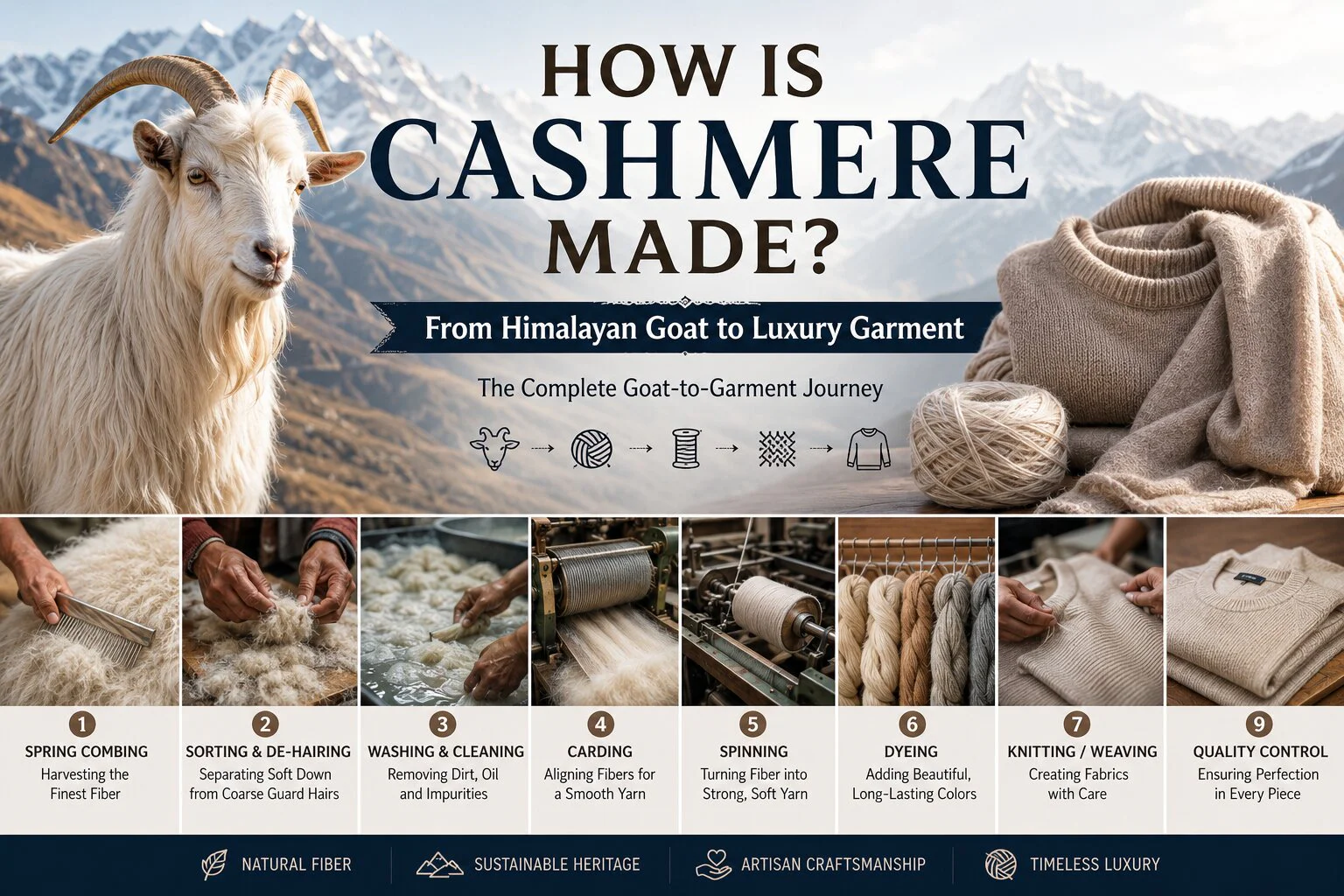
Yarn Construction
Beyond fiber grade, yarn construction affects the final product quality significantly. Key variables include:
Carded vs Combed Yarn — combed cashmere yarn removes shorter fibers and produces a smoother, more uniform yarn with better durability and less pilling. Carded yarn retains more fiber variation and produces a loftier, softer hand feel but is more prone to pilling over time. Most premium knitwear uses combed yarn. Read our detailed comparison of carded vs combed cashmere here.
Ply — the number of yarn strands twisted together. 2-ply cashmere is lightweight and fine; 4-ply produces a heavier, warmer garment. Ply choice affects weight, warmth, and drape. Full guide to cashmere ply here.
Gauge — the number of stitches per inch in the knit construction. Fine gauge (12 to 14 gauge) produces a smooth, lightweight fabric; chunky gauge (3 to 7 gauge) produces a heavier, more textured finish. Gauge selection depends on the intended end use and retail price point.
Private Label and OEM Manufacturing
Most wholesale buyers sourcing knitwear from Nepal are not buying off-the-shelf products. They are developing their own branded product lines using the manufacturer’s production capabilities.
Nepal cashmere manufacturers work with buyers on two primary production models:
OEM (Original Equipment Manufacturing) — the buyer provides the complete design specification — sketch, yarn spec, color, size grading, label, packaging — and the manufacturer produces exactly to that specification. The buyer owns the design. This is the standard model for established brands with their own design team.
ODM (Original Design Manufacturing) — the manufacturer provides existing designs or design development capability, which the buyer can select, modify, and brand as their own. This is suitable for buyers who want to move quickly without a full design process, or who are entering knitwear for the first time. Full breakdown of OEM vs ODM here.
Private Label — whether operating on OEM or ODM basis, buyers can attach their own brand labels, hangtags, packaging, and care labels to all products. Nepal manufacturers handle full private label production as standard.
Custom woven labels, care labels compliant with EU and US textile labeling regulations, and branded packaging are all available as part of the production service.
How to Find a Reliable Cashmere Manufacturer in Nepal
Finding a manufacturer is easy. Finding one you can trust with your brand is harder. Here is what to look for.
Verify Physical Presence
A legitimate manufacturer has a physical factory or workshop you can visit or verify. Ask for the address, request a video call showing the production floor, or use a third-party sourcing agent to conduct an in-person visit if you cannot travel to Kathmandu yourself.
Request Production References
Ask for references from existing wholesale buyers, particularly in your target market. A manufacturer working regularly with US or European brands will have buyers willing to speak to their experience. No references is a red flag.
Evaluate Communication Quality
The quality of your manufacturer’s communication before an order is a reliable indicator of how they will handle issues during production. A manufacturer who responds promptly, asks the right questions about your specification, and proactively flags potential issues is far more valuable than one who simply says yes to everything.
Start with a Sample Before Committing to Bulk
Never place a bulk order without a physical sample in hand. This is non-negotiable regardless of how confident you feel in a manufacturer’s reputation. The sample is your quality control baseline and your reference point for bulk production evaluation.
Check Export Documentation Capability
Your manufacturer needs to be able to provide all documentation required for your import process: commercial invoice, packing list, certificate of origin, and any fiber content certificates required by your country’s textile labeling laws. EU buyers should also confirm GSP Form A documentation availability.
Full checklist for choosing a reliable cashmere supplier here.
Shipping from Nepal: What Buyers Need to Know
Nepal is landlocked, which means all exports move by air or overland to India before sea freight. Most knitwear shipments to the US, UK, Germany, France, and Italy move via:
Air Freight — Tribhuvan International Airport in Kathmandu handles cargo directly to major hubs. Air freight is faster (5 to 10 days to Europe or the US) but significantly more expensive per kg. Suitable for urgent reorders or smaller initial shipments.
Sea Freight — goods move overland from Kathmandu to Kolkata or Chennai in India, then by sea to destination ports. Transit time to European ports is approximately 25 to 35 days; to US East Coast ports approximately 30 to 40 days. Sea freight is the standard mode for bulk seasonal orders.
Incoterms — confirm your preferred Incoterms with your manufacturer at the order stage. FOB Kolkata or FOB Chennai is standard for Nepal exports via sea. This means the manufacturer is responsible for getting goods to the Indian port; the buyer arranges and pays for ocean freight, insurance, and import clearance from that point.
Sustainability and Ethical Manufacturing in Nepal
Sustainability is no longer optional for brands selling into the US, UK, German, French, and Italian markets. Consumer expectations and — increasingly — regulatory requirements mean brands need to be able to speak credibly about their supply chain.
Nepal cashmere manufacturing has genuine sustainability credentials that are worth understanding:
Natural Fiber Production — cashmere, pashmina, yak wool, and bamboo are all natural fibers with a significantly lower environmental footprint than synthetic alternatives. This is a credible sustainability claim that Nepal manufacturers can substantiate.
Nomadic Herding Traditions — the Chyangra goats and yaks that produce Nepal’s finest fibers are raised by nomadic herding communities in high-altitude Himalayan pastures using traditional methods that have existed for centuries. This is a traceability and provenance story that resonates strongly with conscious consumers and premium retail buyers.
Artisan Employment — Nepal’s knitwear manufacturing sector provides skilled employment to thousands of artisans, predominantly women, in Kathmandu and surrounding regions. For brands with social impact commitments, this is a meaningful supply chain story.
What to Ask Your Manufacturer — request information on their yarn sourcing traceability, labor practices, and any third-party certifications they hold or are working toward. Manufacturers working seriously with EU brands are increasingly familiar with OEKO-TEX, GRS, and supply chain transparency requirements.
Frequently Asked Questions
What is the minimum order quantity for cashmere manufacturing in Nepal?
The minimum order quantity at Diamond Knitland is 10 pieces per style, with an average of 4 pieces per color across sizes M, L, XL, and XXL. This makes Nepal manufacturing accessible to small and mid-size brands that cannot meet the high MOQs required by large Chinese factories.
How long does cashmere manufacturing in Nepal take?
Lead time depends on order quantity and design complexity. Sample orders typically take 2 to 3 weeks. Small bulk orders of 10 to 50 pieces per style take 4 to 6 weeks. Larger orders of 200 or more pieces per style typically require 8 to 12 weeks. Always confirm lead time at the order stage and build in shipping transit time when planning your buying calendar.
What is the sampling cost for cashmere from Nepal?
Sample cost is typically double the bulk production unit cost, reflecting the additional setup involved in small-batch sampling. At Diamond Knitland, sampling costs are fully refunded when the buyer proceeds to a bulk order.
Can I put my own brand label on products manufactured in Nepal?
Yes. Private label production — including custom woven labels, hangtags, care labels, and branded packaging — is standard practice for Nepal knitwear manufacturers. Both OEM (buyer-designed) and ODM (manufacturer-designed) production models are available.
Is cashmere from Nepal better than cashmere from China?
Nepal and China produce cashmere at different points of the quality and price spectrum. Nepal’s primary advantage is in fine-grade Himalayan fiber, artisan craft skill, and provenance storytelling. China’s primary advantage is in production volume and price at scale. For premium and luxury retail price points, Nepal manufacturing consistently delivers superior hand feel, quality consistency, and brand story.
Do Nepal cashmere manufacturers export to the US and Europe?
Yes. Nepal has well-established export infrastructure for knitwear shipments to the US, UK, Germany, France, Italy, and across Europe and beyond. Nepal benefits from GSP trade status with the EU, which reduces import duties for European buyers.
Work With Diamond Knitland
Diamond Knitland is a Kathmandu-based knitwear manufacturer specialising in cashmere, pashmina, yak wool, wool, and bamboo knitwear for wholesale and private label buyers worldwide.
We work with boutiques, fashion brands, department store buyers, and importers across the US, UK, Germany, France, Italy, and beyond — from first sample through to full seasonal production.
What we offer:
- MOQ from 10 pieces per style
- Full private label production — labels, hangtags, packaging
- OEM and ODM manufacturing models
- Sampling with bulk order refund policy
- Complete knitwear range — sweaters, shawls, scarves, blankets, accessories
- Fibers: cashmere, Chyangra pashmina, yak wool, merino wool, bamboo, and blends
Get in touch:
📧 biju@diamondknitland.com
📞 +977 9851024416
🌐 diamondknitland.com
Related reading:




Add comment
You must be logged in to post a comment.