

Cashmere Quality Grades Explained: What Buyers Need to Know
Pick up two cashmere sweaters — one priced at $80, one at $400. Both labels say 100% cashmere. Both feel soft in the store. Six months later, one is still beautiful. The other is pilling, stretched, and sitting at the back of a drawer.
The difference is almost always cashmere quality grade.
Cashmere is not a single uniform material. It is a natural fiber that varies significantly in fineness, length, origin, and processing quality — and those variations determine everything about how a finished garment looks, feels, wears, and lasts.
For retail buyers building a product range, importers evaluating suppliers, and brands developing private label knitwear, understanding cashmere quality grades is not optional. It is the foundation of every sourcing decision you will make.
This guide explains exactly how cashmere grading works, what the numbers mean, and what to look for when evaluating a manufacturer’s fiber quality claims.
What Makes Cashmere Different From Regular Wool?
Before getting into grades, it helps to understand what cashmere actually is and why it commands the price it does.
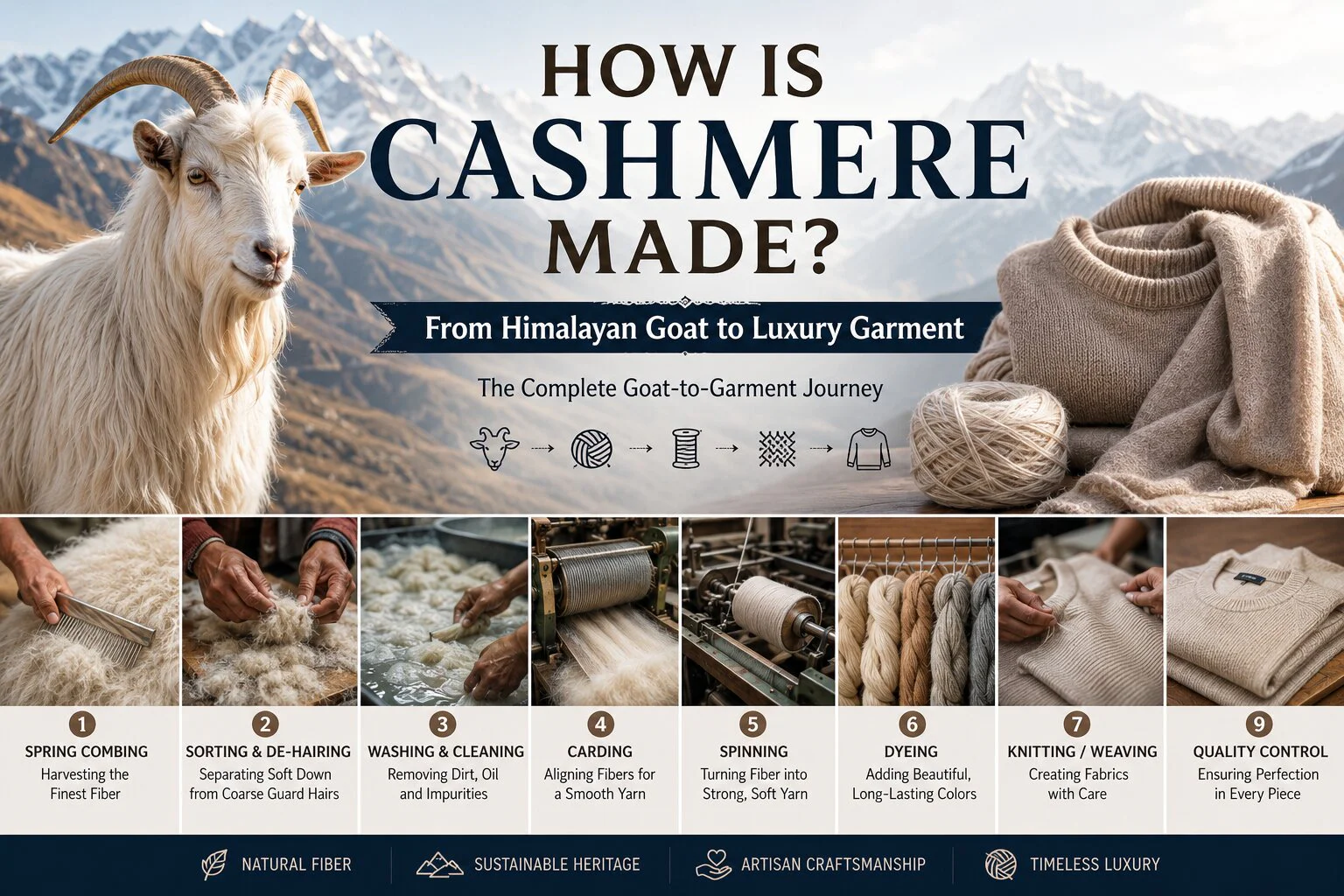
Cashmere comes from the undercoat of the cashmere goat — specifically the soft, fine inner fleece that the animal grows to survive cold winters at high altitude. This undercoat is combed or sheared once a year, typically in spring, and yields only a small amount of usable fiber per animal. A single cashmere goat produces between 150 and 200 grams of raw fiber per year. A single sweater requires the fiber of three to five goats.
This scarcity, combined with the extraordinary softness and insulating properties of the fiber, is what makes genuine cashmere expensive. It is not marketing. It is biology and geography.
What separates premium cashmere from ordinary cashmere is how fine that fiber is — measured in microns — and how carefully it has been processed from raw fleece to finished yarn.
How Cashmere Quality Is Measured
Micron Count: The Most Important Number
The primary measure of cashmere quality is fiber diameter, expressed in microns. One micron is one millionth of a metre. Human hair averages around 70 microns in diameter. Fine cashmere fiber measures between 14 and 19 microns — roughly four to five times finer than human hair.
The finer the fiber, the softer the hand feel, the better the drape, and the higher the quality and price. This relationship between micron count and quality is consistent and well-established across the industry.
Here is how micron count maps to quality perception:
| Micron Range | Quality Level | Hand Feel | Typical Use |
|---|---|---|---|
| 14 to 16 microns | Ultra-fine / luxury | Exceptionally soft, almost silky | Luxury knitwear, fine shawls |
| 16 to 19 microns | Premium | Very soft, smooth | Premium knitwear, quality retail |
| 19 to 22 microns | Standard | Soft but noticeable texture | Mid-range knitwear |
| 22 to 30 microns | Lower grade | Coarser, less refined | Budget knitwear, blends |
| 30+ microns | Below standard | Rough against skin | Not genuine fine cashmere |
The itch threshold for most human skin is around 21 to 22 microns. Fiber above this threshold starts to feel scratchy against sensitive skin, particularly around the neck and wrists. This is why cheap cashmere products often cause irritation despite being technically labeled as cashmere.
Fiber Length: Staple Length Matters Too
Alongside micron count, fiber length — known as staple length — affects quality significantly. Longer fibers produce smoother, stronger yarn that pills less over time. Shorter fibers produce loftier, softer yarn initially but are more prone to pilling as loose fiber ends work their way to the surface with wear and washing.
Premium cashmere yarn uses longer staple fiber. Budget cashmere often uses shorter staple fiber that feels impressively soft in the store but deteriorates quickly in use.
Color: Natural Versus Dyed Fiber
Raw cashmere fiber comes in natural colors ranging from white to beige, grey, and brown. White fiber is the most valuable because it can be dyed to any color without color contamination. Grey and brown fiber can be dyed to darker shades but limits the color palette available.
Undyed natural cashmere — particularly the warm beiges and greys of Himalayan fiber — has its own market among buyers seeking natural and sustainable products.
The Grade A, B, C Classification System
The most widely used cashmere grading framework divides fiber into three grades based primarily on micron count and fiber length. While there is no single global regulatory body enforcing a universal grading standard, the A, B, C framework is broadly understood across the industry.
Grade A Cashmere
Micron count: 14 to 16 microns
Fiber length: 34mm and above
Quality descriptor: Ultra-fine, luxury grade
Grade A is the finest commercially available cashmere. At 14 to 16 microns, it sits at the boundary between high-grade cashmere and fine pashmina. The hand feel is exceptional — the kind of softness that registers immediately when you touch the fabric for the first time and does not diminish with washing and wear when the garment is properly made.
Grade A cashmere is what you find in the knitwear sold by premium heritage brands at $300 to $800+ retail. It is what boutiques and specialty retailers need when their customers are buying a cashmere sweater as an investment rather than a seasonal fashion purchase.
For wholesale buyers: Grade A cashmere commands a higher unit cost but justifies higher retail price points and delivers the product quality that generates repeat customers and positive reviews.
Grade B Cashmere
Micron count: 16 to 19 microns
Fiber length: 28mm to 34mm
Quality descriptor: Premium, high quality
Grade B sits between luxury and commercial grade. It is genuinely good cashmere — noticeably softer than standard wool, warm, and comfortable — but lacks the exceptional hand feel of Grade A. The majority of premium retail cashmere sits in this range.
For buyers developing knitwear at mid-premium retail price points — $100 to $250 — Grade B offers a strong quality-to-cost ratio. It is soft enough to satisfy quality-conscious consumers and durable enough to hold up well over time when properly manufactured.
For wholesale buyers: Grade B is often the right choice for volume lines where Grade A cost is not justified by the retail price point, or for blend products where cashmere is mixed with merino or other fine fibers.
Grade C Cashmere
Micron count: 19 to 30 microns
Fiber length: Below 28mm
Quality descriptor: Commercial grade, lower quality
Grade C cashmere is where the market gets misleading. Products made with Grade C fiber are often labeled simply as “100% cashmere” with no further specification. They feel adequately soft on first contact in a retail environment but deteriorate quickly — pilling within weeks, losing shape after washing, and feeling noticeably coarser over time.
Much of the cheap cashmere available through fast fashion retailers and low-cost online platforms is Grade C or below. Some products labeled as cashmere contain fiber that does not meet even Grade C specifications and is technically mislabeled.
For wholesale buyers: Grade C is not suitable for any brand positioning above the low-price-point fast fashion segment. The reputational risk of customer complaints about pilling and quality deterioration is not worth the cost saving.
Chyangra Pashmina: Nepal’s Grade A Standard
Nepal occupies a unique position in the global cashmere and fine fiber market because of one specific fiber: Chyangra pashmina.
Chyangra pashmina comes from the Chyangra goat — a Himalayan breed that grazes at altitudes above 3,000 metres across Nepal’s high mountain regions. The extreme cold at these altitudes stimulates the growth of an exceptionally fine undercoat, consistently producing fiber in the 14 to 16 micron range — squarely in Grade A territory.
The Nepal government’s Pashmina Industry Promotion Committee certifies authentic Chyangra pashmina and distinguishes it from coarser Indian pashmina and lower-grade cashmere blends that are sometimes mislabeled in international markets. Certified Chyangra pashmina carries a hologram label that buyers can verify.
At Diamond Knitland, Chyangra pashmina sourced from the Himalayan highlands forms the foundation of our finest knitwear and shawl production. The 14 to 16 micron fiber specification is not a marketing claim — it is a verifiable fiber quality standard that our manufacturer can document at the yarn stage.
For brands sourcing from Nepal who want to make legitimate Grade A quality claims to their customers, Chyangra sourcing and certification is the most credible way to substantiate those claims.
How Cashmere Quality Grades Affect the Finished Garment
Understanding fiber grades on paper is one thing. Understanding how grades translate into real-world product differences is what matters for buyers making sourcing decisions.
Softness on First Touch vs Long-Term Softness
Grade A cashmere feels extraordinary from the first wearing and maintains that softness over years of proper care. Grade C cashmere often receives chemical softening treatments during processing to simulate the softness of finer fiber. These treatments wear off after a few washes, leaving the garment feeling noticeably coarser than it did in the store.
If a cashmere product feels remarkably soft for its price, chemical softening is often the explanation.
Pilling
Pilling — the formation of small fiber balls on the fabric surface — is the most common quality complaint about cashmere. It is caused by short fiber ends working their way to the surface of the fabric with friction and wear.
Grade A cashmere with long staple fiber pills very little after the initial break-in period. Grade C cashmere with short staple fiber pills heavily and continuously. No cashmere is completely pill-free, but the difference in pilling behavior between Grade A and Grade C products is dramatic and immediately visible to consumers.
How to remove pilling from cashmere here.
Durability and Shape Retention
Finer, longer fiber produces stronger yarn with better elasticity. Grade A cashmere garments hold their shape through repeated wearing and washing. Grade C garments stretch, sag, and distort more quickly, particularly around necklines, cuffs, and ribbing.
For a brand whose customers are spending $200+ on a sweater, shape retention over multiple seasons is a baseline expectation. It cannot be delivered with Grade C fiber regardless of how well the garment is constructed.
Warmth
Counterintuitively, finer cashmere is not necessarily warmer than coarser cashmere at the same weight. Warmth in knitwear comes from the air trapped within the fiber structure — which is more related to yarn construction, ply, and gauge than to micron count alone.
What finer cashmere delivers is warmth at lower weight. A Grade A cashmere sweater can be feather-light while still providing excellent insulation. This is the warmth-to-weight advantage that makes premium cashmere so valued for travel and layering.
Grading Beyond Fiber: Yarn and Construction Quality
Fiber grade is the starting point, but it is not the whole picture. A Grade A fiber can produce a mediocre garment if the yarn construction and knitting quality are poor. Buyers evaluating manufacturer quality need to look at the full production chain.
Yarn Processing: Carded vs Combed
The same raw cashmere fiber can be processed two ways before spinning into yarn: carding or combing.
Carded yarn retains a mix of fiber lengths, producing a lofty, soft yarn with a slightly fuzzy surface. Combed yarn removes shorter fibers, producing a smoother, stronger yarn with better durability and significantly less pilling.
Premium cashmere knitwear uses combed yarn. Budget cashmere frequently uses carded yarn because the carding process is faster and less wasteful — but the trade-off in long-term quality is significant.
Full comparison of carded vs combed cashmere here.
Ply
Ply refers to the number of individual yarn strands twisted together to form the final knitting yarn. Higher ply produces a heavier, more durable yarn. Lower ply produces a lighter, finer yarn more prone to damage.
For sweaters and heavier knitwear, 2-ply to 4-ply cashmere yarn is standard. For fine shawls and lightweight layering pieces, single-ply or 2-ply is appropriate. Ply choice should match the intended end use and weight specification of the garment.
Full guide to cashmere ply here.
Pure Cashmere vs Cashmere Blends
Some products labeled as cashmere are actually cashmere blended with wool, acrylic, or other fibers. This is not always disclosed clearly on labels, particularly in markets with looser textile labeling enforcement.
Cashmere blends are not inherently dishonest — a 70% cashmere / 30% merino blend can be a quality product at a lower price point — but they should be clearly labeled as blends, not marketed as pure cashmere.
For buyers building a premium product range, pure cashmere is the appropriate specification. For buyers developing accessible price-point products, a clearly labeled cashmere blend can be a legitimate and cost-effective choice.
Pure cashmere vs cashmere blends explained here.
How to Verify Cashmere Quality as a Buyer
When evaluating a manufacturer’s quality claims, do not rely on verbal assurances alone. Here is what to request and check.
Request a fiber certificate — a quality manufacturer can provide a laboratory fiber test certificate showing the micron count and fiber length of the yarn used in your order. Third-party fiber testing from accredited laboratories is the industry standard for verifiable quality claims.
Request a yarn specification sheet — this should detail fiber content, micron count, ply, weight, and processing method (carded or combed) for every yarn used in your collection.
Evaluate the sample physically — rub the sample fabric against the inside of your wrist or your neck. Genuine Grade A cashmere should feel immediately soft with no prickling sensation. Any roughness or itching suggests fiber above 22 microns.
Check the burn test — natural protein fibers including cashmere burn slowly, smell like burning hair, and produce a crushable ash. Synthetic fibers melt, smell like burning plastic, and produce a hard bead. This is a quick authenticity check for samples where you suspect synthetic content. Full guide to identifying real cashmere here.
Wash the sample — before approving bulk production, hand wash the sample according to care label instructions. Evaluate how the garment responds: does it hold its shape? Does it pill heavily after one wash? Does the softness change significantly? These are the quality indicators that matter for end-consumer satisfaction.
Cashmere Grade Quick Reference for Buyers
| Grade | Micron | Staple Length | Best For | Retail Price Point |
|---|---|---|---|---|
| A | 14–16 microns | 34mm+ | Luxury, premium retail | $200–$800+ |
| B | 16–19 microns | 28–34mm | Premium, mid-market retail | $100–$250 |
| C | 19–30 microns | Below 28mm | Budget, fast fashion | Below $100 |
| Chyangra Pashmina | 14–16 microns | 34mm+ | Ultra-luxury, certified origin | $250–$1,000+ |
Frequently Asked Questions
What is the best grade of cashmere?
Grade A cashmere, with a micron count of 14 to 16 microns and staple length above 34mm, is the finest commercially available grade. Chyangra pashmina from Nepal falls within this grade and carries additional certification of Himalayan origin.
How can I tell if cashmere is Grade A?
Request a fiber test certificate from your manufacturer showing micron count and staple length. Physically, Grade A cashmere feels exceptionally soft with no prickling sensation against sensitive skin, and it maintains that softness after washing. It also pills significantly less than lower grade fiber over time.
Is all cashmere from Nepal Grade A?
No. Nepal produces cashmere across all grades. However, Chyangra pashmina — certified by Nepal’s Pashmina Industry Promotion Committee and sourced from Himalayan Chyangra goats — is consistently in the 14 to 16 micron Grade A range. Buyers should specify the fiber grade they require and request documentation.
Why is some cashmere so cheap?
Cheap cashmere is almost always made from Grade C fiber with short staple length, often with added chemical softening treatments that simulate the feel of finer fiber but wear off after washing. Some cheap cashmere products contain blended or mislabeled fiber that does not meet genuine cashmere specifications.
Does micron count affect warmth?
Not directly. Warmth in knitwear comes primarily from yarn construction, ply, and gauge rather than fiber fineness. What finer cashmere delivers is warmth at lower weight — a lightweight Grade A garment can be warmer than a heavier Grade C garment of the same thickness because finer fiber traps air more efficiently.
What micron count is Chyangra pashmina from Nepal?
Chyangra pashmina from Nepal’s Himalayan Chyangra goats produces fiber consistently in the 14 to 16 micron range, placing it firmly in Grade A territory. This is verified through fiber testing and certified by Nepal’s Pashmina Industry Promotion Committee.
Source Your Cashmere Grade Right, From the Right Manufacturer
Understanding cashmere quality grades is only useful if you are working with a manufacturer who can actually deliver verified Grade A or Grade B fiber consistently across orders.
At Diamond Knitland, we work with buyers to specify the right fiber grade for their product range and price point — and we can provide fiber test documentation to support your quality claims to your own customers.
Whether you are building a luxury cashmere line at premium retail price points or developing an accessible cashmere collection for a wider market, getting the grade specification right at the sourcing stage is what determines whether your customers come back.
📧 biju@diamondknitland.com
📞 +977 9851024416
🌐 diamondknitland.com
Related reading:




Add comment
You must be logged in to post a comment.